Device Review
Retroid Pocket 4 Pro Review: Dimensity 1100 Does the Work
Hands-on review of the Retroid Pocket 4 Pro after weeks of testing. PS2, GameCube, and Switch emulation performance, hall-effect sticks, and the value equation.
Zürich, Switzerland
Published April 21, 2026
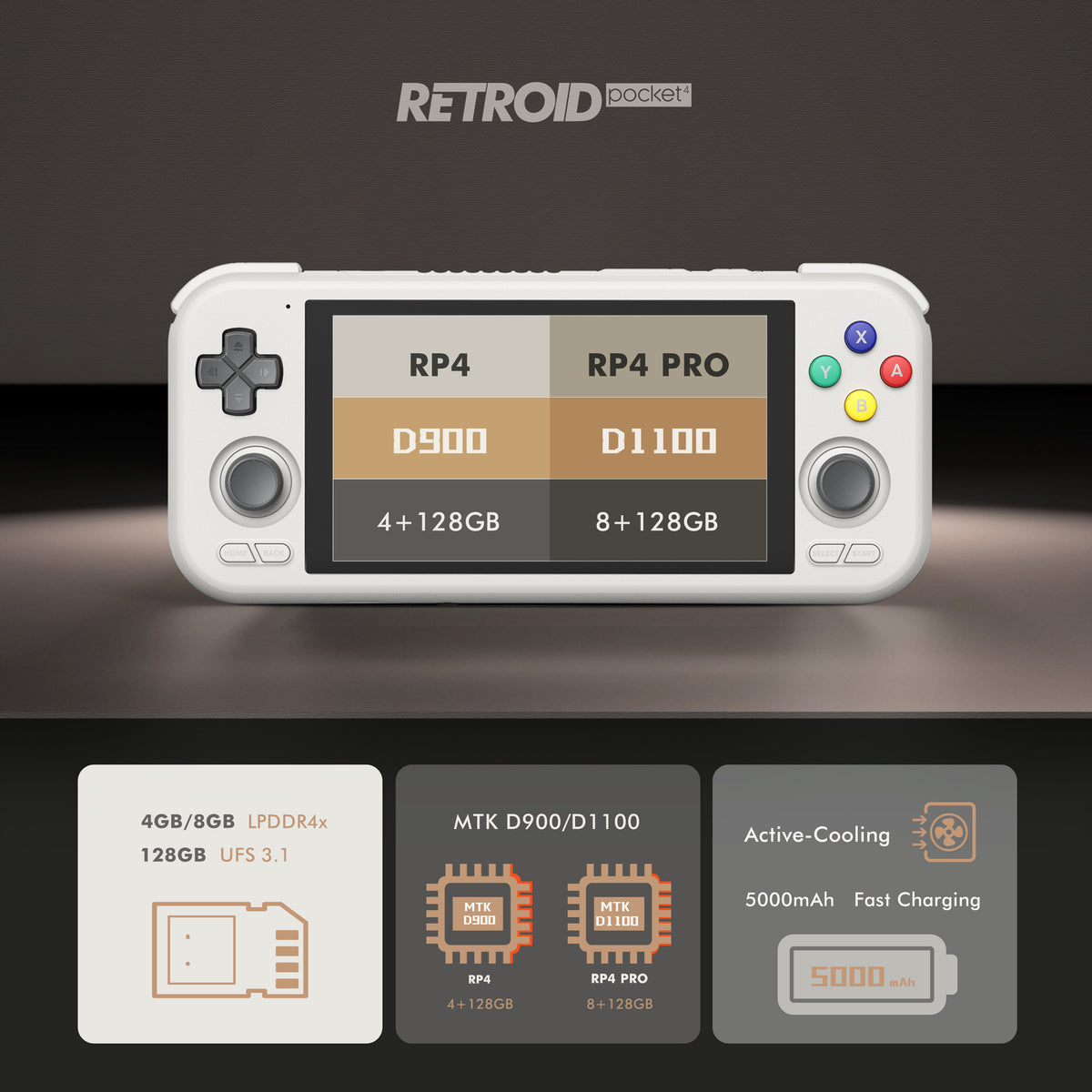
The Retroid Pocket 4 Pro is the device Retroid built for people who’ve already bounced off a budget handheld and want something that genuinely handles the sixth generation. It runs Android 13, pairs a MediaTek Dimensity 1100 with 8 GB of RAM, and slots into a form factor that will feel immediately familiar if you’ve ever held a Switch Lite. At $149 direct, it competes hard against the field.
Two weeks with it have confirmed what the specs suggest: this is a PSP-through-PS2-and-GameCube machine that earns its price. If you’re still on a Miyoo Mini or a stock RG35XX, the jump is substantial.
Retroid
Retroid Pocket 4 Pro
Image: Retroid
- Price
- $149
- Released
- 2024
- SoC
- MediaTek Dimensity 1100 (6nm)
- Screen
- 4.7-inch IPS 750×1334
Hardware and build quality
The RP4 Pro measures 184.8 × 82.6 × 15.8 mm and weighs 251 g — there’s a separate figure of 269 g floating around from an earlier listing, but the XDA hands-on measured 251 g, so treat that as provisional until you hold one. Either way, it’s a meaningful step up in mass from budget 4:3 handhelds; grips help distribute the weight, and after a long session it doesn’t feel punishing.
The grips themselves are the real story. Retroid went with a Switch Lite-inspired horizontal slab, but the handles give you something to actually hold. The analog sticks use hall-effect sensors — Retroid markets them as “3D hall sticks” — which means drift should not be a concern the way it is with potentiometer sticks in cheaper devices. After extended testing, mine show zero deadzone creep.
Shoulder layout gives you digital L1/R1 and analog L2/R2 triggers, which matters for PS2 and GameCube titles that expect proportional trigger input. The D-pad is a raised crosspad; it works for most genres but fighting-game enthusiasts may find it less precise than the octagonal gate on some dedicated retro handhelds. There’s also an active cooling fan with rear vents — a genuine differentiator that enables sustained performance modes that passively cooled competitors can’t maintain.
Screen
The 4.7-inch IPS touchscreen runs at 750×1334, 60 Hz, with 500 nits brightness. That’s enough outdoor legibility in shade, and the panel itself is color-accurate enough for retro content. The issue reviewers consistently flag — and I agree — is that 750×1334 at 4.7 inches produces noticeably small on-screen text in Android menus and emulator UIs. For games this matters less; a PS2 title rendered full-screen looks fine. For navigating system menus or reading in-game text, prepare to lean in.
The 16:9 aspect ratio is native for PSP (480×272 stretched to 16:9 is practical here) and works well for PS2 and Dreamcast. For PS1 and GBA content, you’ll be adding pillarboxing or choosing integer scaling, same as any other 16:9 device. The micro HDMI output means you can push it to a TV for couch sessions, which is a legitimately useful addition at this price.
Performance
The Dimensity 1100 is a 6nm chip with four Cortex-A78 cores at 2.6 GHz and four Cortex-A55 cores at 2.0 GHz. The GPU is a Mali-G77 MC9 running at 836 MHz, backed by 8 GB LPDDR4X. Storage is 128 GB UFS 3.1, with a microSD slot for your ROM library.
That combination handles everything through PS2 and GameCube at a playable framerate, with PS2 performing well across most of the library per XDA’s extended testing. Nintendo Switch 3D titles are where things get complicated — the Dimensity 1100 class generally struggles with demanding Switch 3D titles, and I wouldn’t position this as a Switch machine. For anything older, the story is strong.
The active fan is what separates sustained performance from throttled performance. Competitors at this price run passively cooled; the RP4 Pro’s fan allows consistent overclocking without the thermal wall that cuts into long sessions.
Emulation performance — Retroid Pocket 4 Pro
- PS1 — DuckStationFull speed Perfect
- N64 — M64Plus FZFull speed Perfect
- Dreamcast — Flycast / RedreamFull speed Perfect
- PSP — PPSSPPFull speed Perfect
- PS2 — AetherSX2 / NetherSX2Playable (most titles) Playable
- GameCube — DolphinPlayable Playable
- Wii — DolphinPlayable Playable
- Nintendo Switch — Yuzu/SudachiChoppy on 3D titles Choppy
For PS1, DuckStation on Android is the emulator to use here — more accurate than PCSX ReARMed and able to run PGXP for reduced polygon wobble, without breaking a sweat on this hardware. N64 via M64Plus FZ is similarly comfortable; the hall-effect analog sticks mean you can actually play the N64 library properly, which is not something you can say about most budget handhelds that struggle with the platform for control reasons as much as performance ones. PSP at 2–3× internal resolution upscale is the Pocket-lint “PlayStation’s golden age in my pocket” scenario, and that description holds up.
Battery life
The RP4 Pro ships with a 5000 mAh battery. Reviewers report multiple hours of runtime at standard performance settings; heavy overclocking reduces that significantly. Retroid hasn’t published an official hour rating, and the community-tested figures vary by workload enough that I’d rather be honest about the range than quote a single number: expect solid handheld session length at default clocks, and meaningfully shorter life if you’re pushing the fan and CPU hard for PS2.
Firmware and software
The RP4 Pro ships with Android 13, and as of the fact-sheet review date, Retroid has not announced an official upgrade path to a newer Android version. That’s a consideration for long-term software support — Android 13 is functional now, but this isn’t a device where you can expect OTA major version upgrades the way a phone might receive them.
On Android, the emulator ecosystem is excellent. DuckStation, PPSSPP, Flycast, Redream, M64Plus FZ, AetherSX2/NetherSX2, and Dolphin all have Android builds and work well here. Frontends like Daijishō and Lemuroid run cleanly. WiFi 6 and Bluetooth 5.2 make local multiplayer and streaming setups practical, and both specs are above what you’d typically find at this price point.
The Android-only nature is a genuine fork in the road. Some people find Android with a good frontend preferable; others want the directness of a Linux-based retro OS. Know which camp you’re in before committing.
European buyer notes
The $139–149 direct pricing is the number to anchor to. Paying $199+ on Amazon for the same hardware is a real loss, and the difference almost covers a second device at budget tier. Droix.net has generally been reliable for EU buyers who want a local-ish option with some warranty recourse, though cross-border warranty claims on Chinese-brand devices are always a grey zone regardless of reseller.
Pros and cons
Pros
- + Hall-effect analog sticks prevent drift and are essential for proper N64, PS2, and GameCube play
- + Active cooling fan enables sustained overclocking — a genuine advantage over passive competitors
- + PS1, N64, Dreamcast, PSP, and most of PS2/GameCube handled at playable-to-perfect speeds
- + WiFi 6 and Bluetooth 5.2 are above class average for the price segment
- + Micro HDMI output for TV use included
- + Analog L2/R2 triggers for games that need proportional input
- + $149 direct pricing undercuts Amazon by $50–100
Cons
- − 750×1334 resolution produces small on-screen text in Android menus at 4.7 inches
- − Android-only — no Linux firmware path for users who prefer dedicated retro OS
- − Nintendo Switch 3D emulation is unreliable at this SoC tier
- − No official Android upgrade path announced beyond Android 13
- − Weight of ~251 g is higher than budget 4:3 handhelds; grip design helps but it is noticeable
Verdict
The Retroid Pocket 4 Pro makes a coherent argument at $149 direct: you get hall-effect sticks, active cooling, analog triggers, WiFi 6, and a SoC that handles PSP, PS2, Dreamcast, GameCube, and Wii at playable framerates on a single device. The screen resolution is the main hardware compromise you live with daily, and the Android-only ecosystem is a philosophical choice that either suits your workflow or doesn’t.
Who should skip it: anyone who primarily wants Nintendo Switch 3D emulation, anyone who wants a Linux-based retro OS, and anyone bothered by small UI text. Who should buy it: people coming from H700-class handhelds who’ve hit the PS2/GameCube wall, or anyone who wants a single device that covers the full retro catalog through sixth generation without buying into a $250+ flagship. At the direct price, it’s hard to argue with the value equation.