Device Review
Anbernic RG556 Review: AMOLED Power, Android Caveats
The Anbernic RG556 tested extensively: 5.48-inch AMOLED, Unisoc T820 emulation performance across PS2, GameCube, and 3DS, and whether Anbernic's Android tuning works.
Zürich, Switzerland
Published April 21, 2026
The RG556 is Anbernic’s largest and most powerful Android handheld as of early 2024, built around a 5.48-inch AMOLED display and the Unisoc T820 SoC. It sits at the upper end of Anbernic’s lineup — a device aimed at players who want GameCube, PS2, and PSP emulation at upscaled resolutions rather than just a polished GBA-through-PS1 machine. If you’re coming from something like an RG35XX SP, the jump here is substantial in every dimension: screen size, weight, performance ceiling, and price.
After a few weeks with the RG556, my verdict is straightforward: it’s the best AMOLED handheld under $200 if you want serious 6th-generation emulation, but Anbernic’s Android tuning leaves enough rough edges that you’ll want to spend an hour or two setting it up properly before the hardware shines.
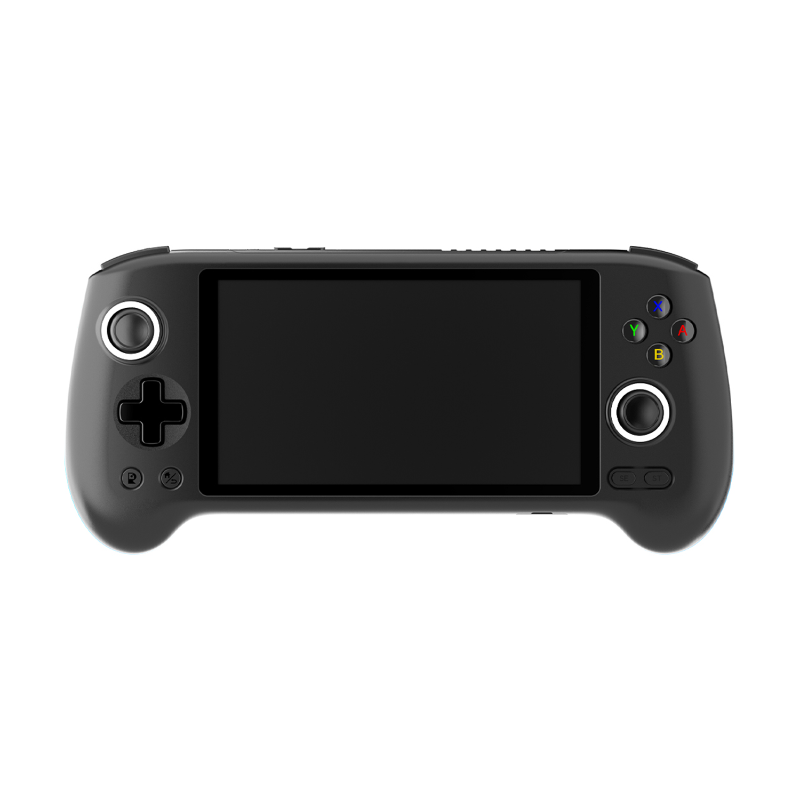
Anbernic
RG556
Image: Anbernic
- Price
- $184.99
- Released
- 2024
- SoC
- Unisoc T820 (6nm EUV)
- Screen
- 5.48-inch AMOLED 1080×1920
Hardware and build quality
The RG556 is a horizontal slab with rear grips, measuring 223 × 90 × 15 mm and weighing 331 g. That weight is real — this is not a device you’ll forget you’re holding. But the rear grip geometry is well-executed: Anbernic has shaped them to cradle your fingers naturally, and most reviewers report the heft becomes comfortable within a session or two. It distributes better than a flat slab of the same mass would.
The analog sticks use hall-effect sensors, which means no drift over time — a meaningful advantage over potentiometer-based sticks that gradually develop dead zones. The L2 and R2 triggers are analog and pressure-sensitive in Xbox mode, so racing games and anything that uses variable trigger input actually works properly. L1 and R1 are digital shoulder buttons. The D-pad is a raised crosspad design — serviceable for 2D games but not the focus of this hardware.
The touchscreen is active and useful in Android context: you can navigate menus, use frontend apps, and access Android settings without reaching for a button combination. RGB lighting sits around the analog sticks; as of the current firmware, the color is not user-customizable, which is a minor but slightly irritating omission on a device at this price point.
Screen
The 5.48-inch AMOLED with full OCA lamination is the headline feature, and it earns that position. At 1080×1920, pixel density is high enough that even text-heavy menus look sharp, and the panel renders blacks as actual black rather than the dark grey you get from IPS. At the RG556’s price tier, the AMOLED is the main visual differentiator versus the Retroid Pocket 4 Pro.
One practical issue: the panel ships with a default blue tint that reviewers consistently flag as distracting. The fix is to go into Settings → Display → Colours & Contrast and switch to Standard mode. It takes thirty seconds and should honestly be the default — if you’re evaluating the display out of the box without this change, you’re not seeing what the panel can actually do.
The 16:9 aspect ratio is a natural fit for PSP titles in PPSSPP, PS2 via AetherSX2/NetherSX2, and anything targeting a widescreen output. For 4:3 content (PS1, N64, GameCube), you’ll be running with pillarboxing or stretching — I leave it at 4:3 with no stretch, which still leaves a very large playfield on a 5.48-inch panel.
Performance
The Unisoc T820 is a 6nm EUV chip with an octa-core configuration: one A76 core at 2.7 GHz, three A76 cores at 2.3 GHz, and four A55 efficiency cores at 2.1 GHz. The GPU is a Mali-G57 MC4 running at 850 MHz. It’s paired with 8 GB LPDDR4X RAM and 128 GB UFS 2.2 internal storage.
This is a meaningful step above Allwinner H700-class Linux handhelds in raw compute, and the Android ecosystem means you get AetherSX2/NetherSX2 for PS2 and Redream for Dreamcast — both of which have no Linux handheld equivalent at this quality level. The T820 lands roughly in the tier where PS2 works at 2x upscale for most titles, GameCube runs at 720p with game-specific caveats, and PSP is effectively a solved problem.
Emulation performance on the Anbernic RG556
- PS1 — Crash Team Racing (DuckStation, 5x upscale)Full speed Perfect
- N64 — Super Mario 64 (M64Plus FZ, 1440×1080)Full speed Perfect
- Dreamcast — via Redream (1920×1440)Full speed Perfect
- PSP — Daxter (PPSSPP, 3x upscale)Full speed Perfect
- PSP — God of War: Ghost of Sparta (PPSSPP, 2x)Full speed Perfect
- PS2 — GTA III (AetherSX2/NetherSX2, 2x upscale)Playable Playable
- PS2 — Metal Gear Solid 3 (2x upscale)Playable Playable
- PS2 — Ratchet & Clank (2x upscale, minor chugging)Playable Playable
- GameCube — Mario Sunshine / Mario Kart DD (720p)Playable Playable
- GameCube — F-Zero GX (720p)Choppy / unplayable Choppy
- Wii — Mario Kart Wii (native res)Playable Playable
- 3DS — Citra MMJ (near-full speed)Playable Playable
- Switch — lightweight 2D titlesChoppy Choppy
A few practical notes from the benchmark data. PS2 at 2x upscale is the sweet spot — pushing to 3x causes performance struggles in demanding titles. GameCube works at 720p (2x upscale) for the majority of titles, but F-Zero GX runs at 40 fps or below and is effectively unplayable at any upscale. Wii runs best at native resolution; 2x upscale introduces performance issues. For 3DS, you must use the Citra MMJ variant — standard Citra is “absolutely unplayable” per community reports, while MMJ brings frame rates to near-full speed, with some texture loading issues remaining. The RG556’s widescreen display is actually a plus here, providing a comfortable layout for 3DS dual-screen emulation.
Switch emulation is a stretch goal, not a selling point. Lightweight 2D titles like Cuphead have frame rate dips; 3D titles struggle meaningfully. If Switch emulation is a priority, you need hardware with a Snapdragon 8 Gen 2 or similar.
Battery life
The RG556 carries a 5500 mAh battery. Anbernic rates it at 8 hours per manufacturer. Charging runs at 5V/2A, with a full charge taking approximately 3.5 hours. For a device with a large AMOLED panel and the T820 running demanding emulation, the 5500 mAh capacity is reasonably sized — measured hours under real gaming load aren’t available in current testing data I can cite specifically, so I’ll note the manufacturer claim and say anecdotally that light gaming sessions consistently outlast long train journeys.
Firmware and software
The RG556 ships with Android 13 and Anbernic’s RG Launcher frontend. The hardware platform is solid. The software layer is a different story. RG Launcher is widely criticized by the community as a subpar experience — it gets in the way more than it helps, especially if you’re used to proper Android frontends.
The good news is that this is Android, so replacing the frontend takes ten minutes. Daijisho and Dig are the most common replacements, and both are significantly better experiences for retro library navigation. The underlying Android 13 install gives you access to the Play Store, AetherSX2 or its NetherSX2 fork, Redream, PPSSPP, M64Plus FZ, Citra MMJ — the full Android emulation ecosystem. That access is a major reason to choose this device over a Linux-based handheld at a similar price.
There are no alternative Linux-based firmwares listed for the RG556 in current support documentation — this is an Android-only device in terms of supported firmware paths, unlike Anbernic’s H700 family which benefits from ArkOS, muOS, and MinUI.
European buyer notes
The MSRP is $184.99, with a sale price of $169.99 available at time of research. EU pricing in euros is not listed on the manufacturer fact sheet — check Anbernic’s direct store or droix.net for current EUR-denominated pricing, which will vary with exchange rates. Warranty support for direct imports is limited to manufacturer RMA processes; there is no local EU consumer warranty through grey-market AliExpress channels.
Pros and cons
Pros
- + 5.48-inch AMOLED with OCA lamination — genuinely excellent display
- + Hall-effect analog sticks eliminate drift
- + Analog L2/R2 triggers for proper racing and action game support
- + 8 GB LPDDR4X RAM and 128 GB UFS 2.2 internal storage
- + Full Android 13 ecosystem — AetherSX2, Redream, M64Plus FZ all available
- + PS2 at 2x upscale, GameCube at 720p, PSP at 3x — meaningful 6th-gen headroom
- + DisplayPort output via USB-C for TV/monitor use
- + Rear grips make the 331 g weight manageable in extended sessions
Cons
- − Stock RG Launcher frontend is poor; expect to replace it immediately
- − Display ships with blue tint — requires manual correction in settings
- − LED stick lighting color is not user-customizable in current firmware
- − 331 g is heavy; not a pocketable device
- − GameCube performance is game-dependent — F-Zero GX is effectively unplayable
- − Switch emulation is limited to lighter 2D titles
- − No Linux firmware path; tied to Android ecosystem
- − 3x PS2 upscale causes struggles in demanding titles
Verdict
The RG556 earns its place as Anbernic’s Android flagship for 2024. The AMOLED display is a genuine differentiator — once you correct the color mode — and the Unisoc T820 with 8 GB RAM delivers real PS2, GameCube, and PSP emulation headroom rather than theoretical compatibility. Hall-effect sticks, analog triggers, and a 5500 mAh battery round out a hardware package that the MSRP doesn’t undercut.
The caveats are real too. You will need to replace the frontend software. GameCube performance has hard limits — don’t buy this expecting F-Zero GX at full speed. Switch emulation is a stretch, not a feature. And at 331 g, this device lives on your couch or in a backpack, not a jacket pocket. If those tradeoffs fit your use case — and for 6th-generation emulation on a beautiful AMOLED screen, they often will — the RG556 is a well-justified purchase.