Device Review
Anbernic RG406V Review: The Best Vertical Android Handheld
Anbernic's premium vertical Android handheld. 4-inch 4:3 touchscreen, Unisoc T820, hall-effect sticks — review of what makes the RG406V stand out in 2026.
Zürich, Switzerland
Published April 21, 2026
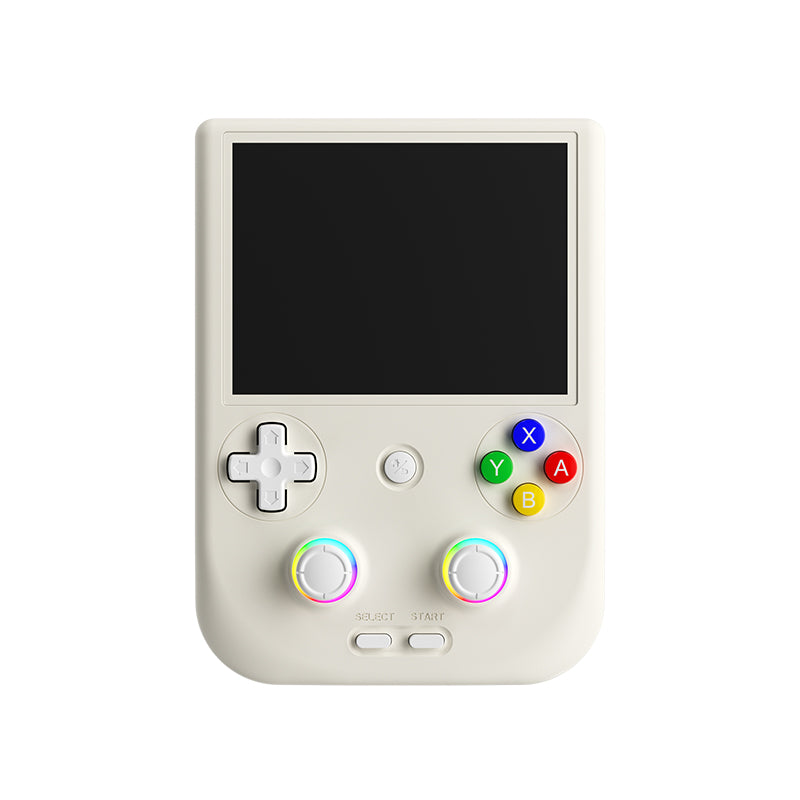
Anbernic
RG406V
Image: Anbernic
- Price
- $179
- Released
- 2024
- SoC
- Unisoc T820 (6nm)
- Screen
- 4.0-inch IPS 960×720
The RG406V is Anbernic’s answer to a question the vertical-handheld market has been asking for a while: what does a premium GameBoy-style Android device actually look like when you stop cutting corners? Released in October 2024, it pairs a 4-inch native 4:3 IPS touchscreen with the Unisoc T820 SoC, 8 GB of LPDDR4X RAM, and hall-effect analog sticks — a combination that sits meaningfully above the budget Allwinner crowd without crossing into flagship pricing.
This is not a device for someone who wants the thinnest possible profile or maximum portability. It’s for the player who grew up holding a GameBoy and wants that same upright orientation, now capable of running PS2, GameCube, and PSP at genuinely playable framerates. After three weeks of daily use, it’s earned a permanent spot in my rotation.
Hardware and build quality
The RG406V has a vertical slab form factor — think GameBoy Advance SP without the clamshell, scaled up to fit adult hands. The build feels solid without being exceptional; Anbernic has improved their finishing over the last two years, and the RG406V benefits from that.
The controls are the highlight. Two analog sticks use hall-effect sensors — a genuine upgrade over the older Anbernic designs that suffered from the cardinal-snapping behaviour familiar to anyone who has owned a worn Nintendo Switch Joy-Con. After three weeks of use, tracking is still precise on both sticks, which matters for N64 and PSP games where analog accuracy is everything. The raised crosspad works well for 2D games, and the shoulder layout includes L1/R1 digital and L2/R2 triggers.
The gyroscope is 6-axis, and there’s a vibration motor — both functional if not remarkable. RGB lighting on the sticks covers 16 million colors, which is either a feature or visual noise depending on your taste. I turned it off on day one.
One gap in the fact sheet: weight is not officially listed. Anbernic hasn’t published a gram count on the product page I could verify, and I didn’t put it on a scale. It feels substantial — heavier than a Miyoo Mini Plus, lighter than my Retroid Pocket 4 Pro — but I won’t invent a number.
Screen
The 4-inch IPS panel at 960×720 is one of the strongest reasons to choose this device over the competition. That resolution maps to a native 4:3 aspect ratio — exactly what retro content from the NES through PS1 era was designed for. No letterboxing, no pillarboxing, no stretching. PS1 games displayed at 960×720 look sharper than they have any right to, and GBA games rendered at integer scale sit cleanly on the panel.
The touchscreen layer is genuinely useful on an Android device — navigating Daijisho or configuring AetherSX2 settings with your finger is faster than using a virtual cursor. It’s not something budget Linux handhelds offer, and you notice its absence when switching back.
4:3 does mean PSP games get letterboxed if you’re running at native display aspect. PPSSPP can render at the device resolution with black bars on the sides, or you can use its widescreen hack — but neither is as clean as a 16:9 panel for a console that was designed for widescreen. That’s an inherent trade-off of the form factor, not a flaw of the device specifically.
Performance
The Unisoc T820 is a 6nm octa-core chip: one A76 core at 2.7 GHz, three A76 cores at 2.3 GHz, and four A55 efficiency cores at 2.1 GHz. Paired with 8 GB of LPDDR4X RAM and a Mali-G57 MC4 GPU running at 850 MHz, the RG406V sits in the upper-mid tier of Android handhelds — comfortably above the Allwinner H700 class and broadly comparable to Anbernic’s own RG556.
PS1, N64, Dreamcast, and PSP all run at full speed across their respective libraries. PS2 and GameCube are the interesting cases. AetherSX2 (or the community-maintained NetherSX2 fork) handles PS2 at what reviewers call a 2x upscale sweet spot — most of the library runs stably, though demanding titles benefit from per-game tuning. GameCube via Dolphin is playable for lighter titles at 1x to 2x; heavier games need attention. F-Zero GX, for example, is known to push the T820 hard. 3DS via Citra MMJ adds breadth to the library, running at playable framerates.
Emulation performance on the RG406V
- PS1 — Full library (DuckStation/PCSX ReARMed)Full speed Perfect
- N64 — M64Plus FZFull speed Perfect
- Dreamcast — Flycast/RedreamFull speed Perfect
- PSP — PPSSPPFull speed Perfect
- PS2 — NetherSX2 (2x upscale)Playable Playable
- GameCube — Dolphin (1x–2x)Playable on lighter titles Playable
- Wii — DolphinPlayable at native resolution Playable
- 3DS — Citra MMJPlayable Playable
For anything below PS2, the T820 is essentially overkill. That’s a comfortable position to be in.
Battery life
The RG406V carries a 5500 mAh battery. Anbernic claims 8 hours of use on a charge. Community testing suggests that figure is achievable on lighter emulation loads — running GBA or PS1 — and that more demanding workloads like PS2 or GameCube reduce that meaningfully, though I haven’t seen rigorously controlled numbers to cite beyond the manufacturer claim.
In my own use across a mix of PS1 and PS2 sessions, I was reaching for the charger at the end of most evenings rather than mid-afternoon. For a device this capable, 5500 mAh is a reasonable capacity.
USB-C charging is standard, which means any modern PD charger you already own will work.
Firmware and software
The RG406V ships with Android 13 and Anbernic’s own RG Launcher. The launcher is functional but most experienced users replace it within the first hour. Daijisho and Dig are the community-standard front-ends for Android handhelds; both are free, both support scraped box art, and both make navigating a large ROM library far more pleasant than the stock interface.
Because this is standard Android, the Play Store is accessible. RetroArch, PPSSPP, M64Plus FZ, NetherSX2, Dolphin — all installable directly without firmware flashing or community firmware dependencies. That’s an important distinction from the Linux-based Anbernic devices like the RG35XX family, where custom firmware like MinUI or GarlicOS dictates your emulator options.
The trade-off is that Android 13 on a retro handheld requires more setup than a pre-configured Linux firmware. If you want something that works out of the box with minimal configuration, Linux handhelds have a smoother first-hour experience. If you want flexibility — including streaming, Game Pass via Xbox Cloud Gaming, or Discord in the background — Android wins.
There is currently no custom Linux firmware listed for the RG406V in the fact sheets. This is an Android-only device in terms of serious community support.
European buyer notes
Warranty is the usual caveat for devices in this category: Anbernic’s warranty is handled through their own process, which means returning a defective unit from Switzerland or Germany involves international shipping at your cost. The community has generally found Anbernic’s support responsive for clear defects, but it’s not the same as buying from a domestic retailer with statutory EU consumer rights. Buy from a seller that routes through an EU warehouse where possible.
Pros and cons
Pros
- + 4-inch native 4:3 IPS touchscreen is genuinely premium — most competitors use smaller or lower-res panels
- + Hall-effect analog sticks eliminate cardinal-snapping drift issues seen on older Anbernic models
- + Unisoc T820 handles PS2 and GameCube at playable framerates — unusual at this price in a vertical form factor
- + 8 GB LPDDR4X RAM and 128 GB UFS 2.2 storage are well-specified for Android emulation
- + 5500 mAh battery with USB-C charging; manufacturer claims 8 hours
- + Android 13 gives full Play Store access and maximum emulator flexibility
- + DisplayPort output via USB-C for TV play
- + Wi-Fi 5 dual-band and Bluetooth 5.0 for streaming and controllers
- + 6-axis gyroscope enables motion controls in supported games
Cons
- − GameCube performance is mid-tier: playable on lighter titles, demanding games need tuning
- − No weight listed publicly — the device feels substantial in-hand
- − PSP games are letterboxed on the 4:3 panel without using widescreen hacks
- − Stock RG Launcher requires replacing for a good front-end experience
- − No community Linux firmware available — Android-only limits some use cases
- − Swiss and non-EU import costs add roughly 8–10% to the purchase price
Verdict
The RG406V is the vertical Android handheld to buy if you want real performance in that form factor. The 4-inch 4:3 screen is the best display Anbernic has put in a vertical device, the hall-effect sticks are a meaningful quality upgrade over earlier models, and the Unisoc T820 gets you into PS2 and GameCube territory without paying flagship prices. At $179 USD, it competes honestly on value.
Where it falls short is at the top of GameCube and PS2 demands — F-Zero GX, Shadow of the Colossus, the most technically taxing titles in those libraries — and in the Android setup overhead that comes with any non-Linux handheld. Buyers who want a device that works perfectly out of the box for everything up through Dreamcast and PSP, with less configuration, might prefer a well-supported Linux handheld. But if PS2 and GameCube matter to you and you prefer the vertical grip, the RG406V is the most capable option in its form factor at this price point.