Emulation
Best Handhelds for SNES Emulation in 2026
SNES runs on every modern handheld at full speed. But screen aspect ratio, D-pad quality, and emulator choice make real differences — here's where to spend.
Zürich, Switzerland
Published May 4, 2026
The good news about SNES emulation: it’s essentially a solved problem. A 3.58 MHz 65C816-based CPU running at modest clock speeds means even budget hardware from 2023 handles the entire library at full speed. The bad news is that “full speed” is the floor, not the ceiling — screen aspect ratio, D-pad quality, enhancement chip accuracy, and firmware choice all separate a mediocre SNES handheld from one that actually feels right for the library.
The trickier games are the ones running coprocessors: Star Fox and its Super FX chip, Super Mario RPG with its SA-1, Yoshi’s Island with Super FX 2 scaling effects. These need an emulator that handles coprocessor cores correctly. Snes9x does; older speed-optimized forks like Snes9x 2005 may not. Get the hardware and firmware combination right and SNES becomes genuinely effortless — get it wrong and you’re debugging frame drops on a 30-year-old platformer.
What it takes to emulate SNES
The SNES platform sheet puts the CPU requirement at trivial, RAM requirement at 32 MB, and GPU requirement at any. In practice, any ARM Cortex-A53 device from the last five years runs the entire library without breaking a sweat.
The one area requiring attention is accuracy sensitivity, rated medium by the platform sheet. Base SNES games are fully solved; enhancement chip titles demand more from your emulator than from your hardware. Snes9x on any of the handhelds below handles Super FX and SA-1 correctly. If you want cycle-accurate output or widescreen hacks via bsnes-hd, you’ll want the extra headroom of a slightly more powerful device — though the H700-class hardware handles it fine.
Aspect ratio matters more for SNES than for almost any other retro platform. The SNES outputs 256×224 natively — a near-perfect fit for a 4:3 screen. Handhelds with 4:3 panels (640×480) display SNES content without scaling artifacts. The Trimui Smart Pro’s 16:9 panel introduces black bars unless you’re using widescreen hacks, which is its own legitimate draw.
Top picks
1. Miyoo Mini Plus — best budget pick
SNES emulation — Miyoo Mini Plus
- SNES — Super Mario World (Snes9x)Full speed Perfect
- SNES — Star Fox (Snes9x, Super FX)Full speed Perfect
- SNES — Chrono Trigger (Snes9x)Full speed Perfect
The Miyoo Mini Plus runs SNES perfectly — the fact sheet backs this up explicitly, with community reviews calling the experience “absolutely flawless.” At $50 and 162 g, it’s the lightest and cheapest device in this roundup, and its 3.5-inch 640×480 IPS panel is a native 4:3 match for SNES content.
The D-pad is the real differentiator here. The community consensus is consistent: it’s SNES-grade quality, which matters enormously for a platform built around games like Super Metroid and A Link to the Past. You’ll spend hundreds of hours on this D-pad and you won’t be fighting it.
The SigmaStar SSD202D (dual-core Cortex-A7 @ 1.2 GHz) and 128 MB RAM mean you’re locked to 16-bit and earlier content — N64 is broken, Dreamcast doesn’t run. For SNES specifically, the hardware ceiling is irrelevant. Install OnionOS (the de facto standard firmware; the stock launcher is almost never used), pick Snes9x or Snes9x 2002/2005 for maximum compatibility, and you’re done.
One constraint: the MMP has no L2/R2 shoulder buttons. Most SNES games use four buttons maximum, so this rarely matters — but it’s worth knowing if you plan to mix in PS1 content alongside your SNES library.
2. Anbernic RG35XX SP — best for screen protection
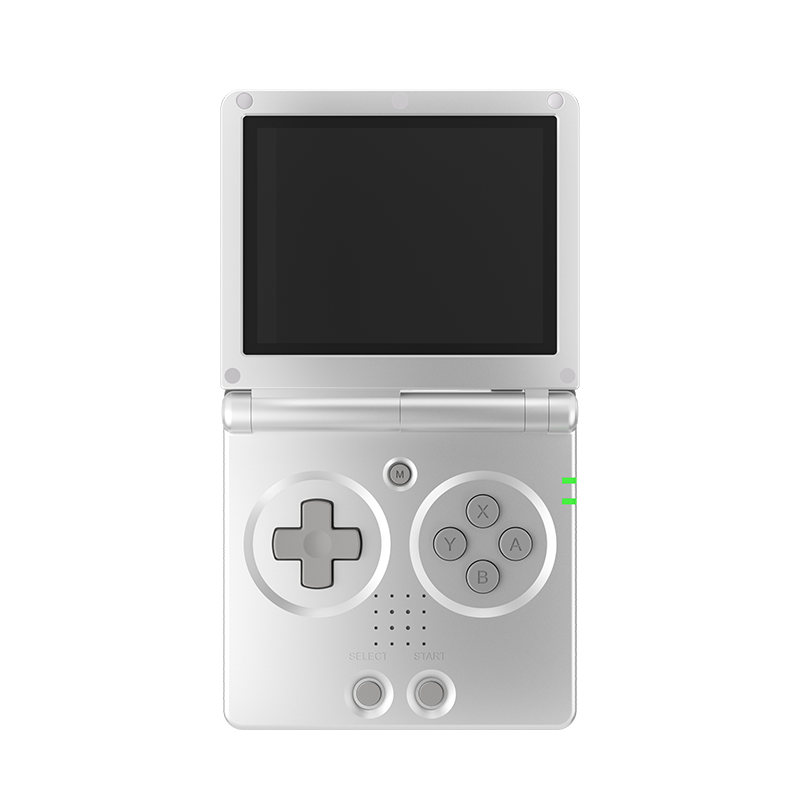
Anbernic
RG35XX SP
Image: Anbernic
- Price
- $64.99
- Released
- 2024
- SoC
- Allwinner H700
- Screen
- 3.5-inch IPS 640×480
The RG35XX SP runs the same Allwinner H700 quad-core Cortex-A53 @ 1.5 GHz as the RG35XX Plus, with 1 GB LPDDR4 — a significant step up from the Miyoo Mini Plus’s 128 MB. SNES performance is perfect across the tested library, with room to push N64 and Dreamcast when you want a change of pace.
The defining feature is the clamshell form factor. It’s a deliberate GBA SP tribute and it works: the 3.5-inch 640×480 IPS panel folds closed and is fully protected in a pocket. At 192 g, it’s slightly heavier than the Miyoo Mini Plus but still genuinely portable. The 3300 mAh battery carries a manufacturer claim of 8 hours.
The RG35XX SP also has mini HDMI out and dual microSD slots. Custom firmware support includes muOS (BEANS build) and Knulli. The mono speaker is a real downgrade versus the Miyoo Mini Plus’s front-facing stereo, which matters during long SNES sessions — though headphones or Bluetooth speakers resolve it immediately.
3. Anbernic RG35XX Plus — best all-rounder at this price
The RG35XX Plus shares the H700 SoC and 640×480 IPS screen with the SP, but in a horizontal Game Boy-style slab at 186 g. It adds stereo front-facing speakers and a proper HDMI output — things the SP trades away for the clamshell form.
SNES is perfect on the RG35XX Plus across the board. The 3300 mAh battery, same firmware ecosystem (muOS BANANA build, GarlicOS, Knulli, MinUI), and dual microSD slots make this the most practical daily driver of the three H700 devices. The $60 price sits between the Miyoo Mini Plus and the SP.
The main decision between the Plus and SP is form factor preference: slab vs. clamshell, stereo vs. mono speakers, HDMI vs. compactness. For pure SNES play, either works identically.
4. Trimui Smart Pro — best for widescreen hacks
The Trimui Smart Pro is the outlier here. Its Allwinner A133P (quad-core Cortex-A53 @ 1.8–2.0 GHz) runs SNES perfectly, but the hardware isn’t the pitch — the 4.96-inch 1280×720 IPS panel is. That’s a 16:9 screen at 294 ppi, and it means native SNES content will have black bars unless you deploy widescreen hacks via bsnes-hd.
Those widescreen hacks are the reason to buy this device for SNES. A Link to the Past, Super Metroid, and Chrono Trigger with extended horizontal view on a crisp 720p display is a genuinely different way to experience these games. CrossMix OS (the community firmware) handles the setup and supports the bsnes-hd core.
At 231 g and a 5000 mAh battery, it’s bulkier than the H700 devices. Two analog sticks make it the right call if you want a single device covering SNES through PSP. The $69.99 price is reasonable for what it offers.
Emulator recommendations
The platform sheet lists four emulators for SNES. Here’s how they map to the devices above:
| Emulator | Best for | Notes |
|---|---|---|
| Snes9x | All devices | Balanced accuracy and performance; handles Super FX, SA-1, DSP coprocessors; available as libretro core on all four devices |
| Snes9x 2005 | Miyoo Mini Plus (128 MB RAM) | Speed-optimized older fork; excellent on constrained hardware; may have edge-case coprocessor gaps |
| bsnes / bsnes-hd | RG35XX Plus, Trimui Smart Pro | Cycle-accurate; required for widescreen hacks; more demanding but runs fine on A53-class hardware |
| Higan | N/A | PC-only; not available for any handheld in this guide |
For the Miyoo Mini Plus on OnionOS, Snes9x is the default and the right choice. For the H700 Anbernic devices and Trimui Smart Pro, Snes9x is still the easiest path; switch to bsnes-hd only if you’re specifically chasing widescreen expansion or cycle-accurate audio.
Reference games
The platform sheet defines these as the meaningful benchmarks for SNES emulation difficulty:
| Game | Difficulty | Miyoo Mini Plus | RG35XX SP | RG35XX Plus | Trimui Smart Pro |
|---|---|---|---|---|---|
| Super Mario World | Easy | Perfect | Perfect | Perfect | Perfect |
| A Link to the Past | Easy | Perfect | Perfect | Perfect | Perfect |
| Super Metroid | Easy | Perfect | Perfect | Perfect | Perfect |
| Chrono Trigger | Easy | Perfect | Perfect | Perfect | Perfect |
| Super Mario RPG | Medium (SA-1 chip) | Perfect (Snes9x) | Perfect (Snes9x) | Perfect (Snes9x) | Perfect (Snes9x) |
| Yoshi’s Island | Medium (Super FX 2) | Perfect (Snes9x) | Perfect (Snes9x) | Perfect (Snes9x) | Perfect (Snes9x) |
| Star Fox | Hard (Super FX) | Perfect (Snes9x) | Perfect (Snes9x) | Perfect (Snes9x) | Perfect (Snes9x) |
All four devices handle the entire reference library when running a modern Snes9x build. The Miyoo Mini Plus’s hardware constraints don’t show up on SNES at all — the platform is simply too lightweight to stress any of them.
Settings that actually help
For 4:3 handhelds (Miyoo Mini Plus, RG35XX SP, RG35XX Plus): set integer scaling or 1:1 pixel mapping. The 640×480 native screen resolution is an exact 2× scale of SNES’s 256×224 output — sharp pixels, no filtering required. Turning on bilinear filtering is actively counterproductive on these screens.
For the Trimui Smart Pro’s 16:9 panel: decide upfront whether you want black bars or widescreen. Black bars with integer scaling are the accurate approach; bsnes-hd widescreen hacks require loading the correct patch per game. CrossMix OS streamlines this considerably.
Enhancement chip games (Star Fox, Super Mario RPG, Yoshi’s Island) require no special settings beyond using Snes9x rather than Snes9x 2005. The 2005 fork handles most titles correctly but coprocessor accuracy isn’t guaranteed.
Don’t bother with
The Miyoo Mini Plus’s constraint isn’t relevant for SNES, but if you’re looking at older or weaker devices in the sub-$40 range — legacy RK3326 devices, or original RG35XX variants — be aware that SNES itself will still run, but the D-pad quality and screen resolution gaps are real. The platform sheet doesn’t list any device from the covered fact sheets as broken for SNES; this is a platform that runs everywhere.
What the fact sheets do flag: the Miyoo Mini Plus is flat-out broken for N64 and Dreamcast. If you want a device that covers SNES as a primary concern but also handles 3D fifth-gen content when the mood strikes, the RG35XX SP or RG35XX Plus are the minimum viable option. The Miyoo Mini Plus is a deliberate 16-bit specialist.
Bottom line
For pure SNES emulation on a budget, the Miyoo Mini Plus at $50 is the answer. The D-pad is legitimately SNES-grade, the 640×480 IPS panel is a native 4:3 match, OnionOS runs Snes9x without any configuration overhead, and the 162 g weight means it fits in any pocket. Its hardware ceiling is low, but that ceiling is irrelevant for this platform.
If you want screen protection, dual microSD slots, and upgrade headroom into N64 and Dreamcast territory, the RG35XX SP at $64.99 covers the same SNES ground on H700 hardware inside a clamshell that protects the screen in a bag or pocket. The mono speaker is a step down from the Miyoo Mini Plus’s stereo setup, but the Allwinner H700 quad-core gives you meaningful additional emulation range. Either way, SNES in 2026 is a solved problem — the only thing left to choose is which form factor you’ll enjoy holding for the next few hundred hours.
Pros
- + SNES runs at full speed on every device in this guide — no exceptions
- + 4:3 screens on H700 Anbernic devices and Miyoo Mini Plus display SNES natively without scaling
- + Snes9x handles all enhancement chip games (Super FX, SA-1, DSP) on all devices
- + Miyoo Mini Plus D-pad is community-rated as SNES-grade quality
- + Trimui Smart Pro supports bsnes-hd widescreen hacks on its 16:9 720p panel
Cons
- − Miyoo Mini Plus has no L2/R2 — limits mixed SNES/PS1 libraries
- − Trimui Smart Pro shows black bars on native SNES content without widescreen hacks
- − RG35XX SP has a mono speaker
- − Miyoo Mini Plus's 128 MB RAM rules out N64, Dreamcast, and beyond